
Product Description of Boron Trifluoride Diethyl Etherate CAS#109-63-7
Boron Trifluoride Diethyl Etherate is a stable complex of boron trifluoride and diethyl ether, widely recognized as an important Lewis acid catalyst in organic chemistry. It provides the reactive properties of boron trifluoride while offering improved handling characteristics compared with the gaseous form.
As an effective catalyst, Boron Trifluoride Diethyl Etherate is commonly used in polymerization reactions, alkylation processes, isomerization reactions, and other organic synthesis transformations. Its strong electron-accepting ability enables efficient activation of various organic substrates.
Due to its excellent compatibility with multiple functional groups, Boron Trifluoride Diethyl Etherate can interact with ethers, amines, phenols, ketones, thioethers, and related derivatives to form stable complexes, expanding its usefulness in pharmaceutical synthesis, specialty chemicals, and advanced organic manufacturing.
With its high catalytic efficiency, versatile reaction behavior, and convenient liquid form, Boron Trifluoride Diethyl Etherate remains an important reagent in modern synthetic chemistry.
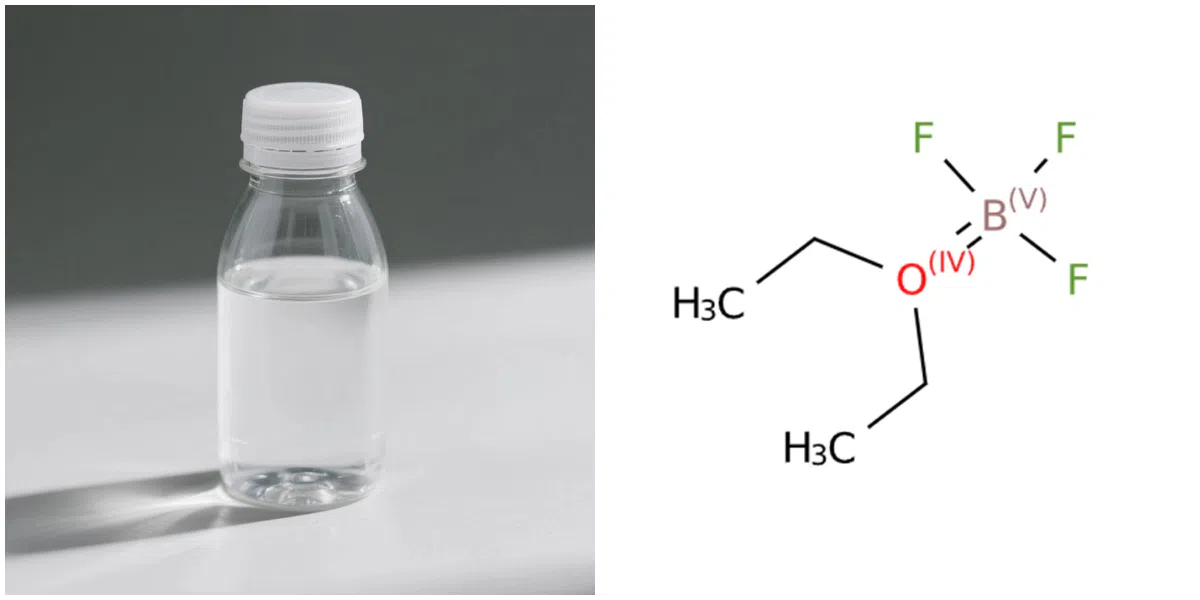
Boron trifluoride diethyl etherate Chemical Properties
| Melting point | −58 °C(lit.) |
| Boiling point | 126-129 °C(lit.) |
| Density | 1.15 g/mL(lit.) |
| Vapor density | 4.9 (vs air) |
| Vapor pressure | 4.2 mm Hg ( 20 °C) |
| Refractive index | n20/D 1.344(lit.) |
| Fp | 118 °F |
| Storage temp. | Store below +30°C. |
| Solubility | Miscible with ether and alcohol. |
| Form | liquid |
| Specific Gravity | 1.126 (20/4℃) |
| Color | brown |
| Explosive limit | 5.1-18.2%(V) |
| Water Solubility | Reacts |
| Sensitive | Moisture Sensitive |
| Hydrolytic Sensitivity | 7: reacts slowly with moisture/water |
| Merck | 141,350 |
| BRN | 3909607 |
| Exposure limits | ACGIH: TWA 0.1 ppm; Ceiling 0.7 ppm |
| Stability | Stable. Highly flammable. May form explosive peroxides in contact with air or oxygen. Reacts exothermically with water to form extremely flammable diethyl ether and toxic, corrosive boron trifluoride hydrates. Also incompatible with bases, amines, alkali metals. |
| InChIKey | MZTVMRUDEFSYGQ-UHFFFAOYSA-N |
| CAS DataBase Reference | 109-63-7(CAS DataBase Reference) |
| NIST Chemistry Reference | Boron trifluoride etherate(109-63-7) |
| EPA Substance Registry System | Boron, trifluoro[1,1'-oxybis[ethane]]-, (T-4)- (109-63-7) |
Safety Information
| Hazard Codes | T,C |
| Risk Statements | 10-14-20/22-35-48/23-34-14/15-23-22 |
| Safety Statements | 16-23-26-36/37/39-45-8-28A-43 |
| RIDADR | UN 2604 8/PG 1 |
| WGK Germany | 3 |
| F | 10 |
| Autoignition Temperature | 185 °C DIN 51794 |
| TSCA | Yes |
| HazardClass | 8 |
| PackingGroup | I |
| HS Code | 29319090 |
| Hazardous Substances Data | 109-63-7(Hazardous Substances Data) |
Product Application of Boron Trifluoride Etherate CAS#109-63-7
Boron Trifluoride Etherate is a highly versatile Lewis acid catalyst widely used in organic synthesis and industrial chemical processes. It is commonly applied as a catalyst for cationic polymerization reactions, supporting the production of advanced polymer materials and specialty chemicals.
In the polymer industry, Boron Trifluoride Etherate plays an important role as a catalyst in the manufacture of butadiene rubber, polyformaldehyde, and other high-performance polymer products, helping improve reaction efficiency and product quality.
It is also utilized as a key intermediate and chemical source in the preparation of boron–hydrogen-based high-energy materials and in boron isotope separation processes, including the enrichment and extraction of the boron-10 isotope.
Due to its strong catalytic activity and broad reaction compatibility, Boron Trifluoride Etherate is widely used in organic synthesis, polymer production, specialty chemical manufacturing, and advanced material research.