Product Description of Acrylonitrile CAS#107-13-1
Acrylonitrile is a colorless, flammable liquid with the molecular formula C₃H₃N. It is an industrially produced chemical compound that does not occur naturally and is manufactured on a large scale to meet the needs of various chemical and polymer industries.
As a key monomer and chemical intermediate, acrylonitrile is primarily used in the production of synthetic fibers, plastics, and specialty chemicals. It is the main feedstock for manufacturing acrylic and modacrylic fibers, as well as high-performance ABS (acrylonitrile-butadiene-styrene) plastics and SAN (styrene-acrylonitrile) resins.
Acrylonitrile-based materials are widely utilized in automotive parts, electrical and electronic components, household goods, packaging materials, office equipment, luggage, and building products due to their excellent mechanical properties and durability.
Additionally, acrylonitrile serves as a precursor for producing adiponitrile, an important intermediate used in the manufacture of nylon, dyes, pharmaceuticals, and other fine chemical products. With its diverse industrial applications and strong downstream demand, acrylonitrile remains one of the most important chemical raw materials in modern industry.
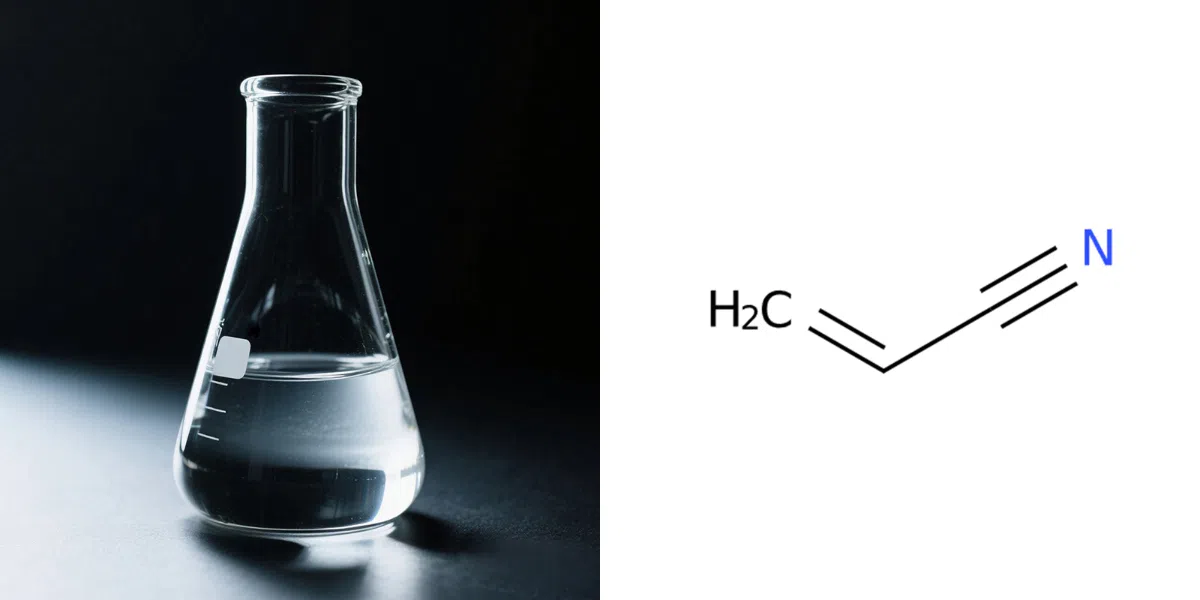
Acrylonitrile Chemical Properties
| Melting point | -83 °C (lit.) |
| Boiling point | 77 °C (lit.) |
| density | 0.806 g/mL at 20 °C |
| vapor density | 1.83 (vs air) |
| vapor pressure | 86 mm Hg ( 20 °C) |
| refractive index | n20/D 1.391(lit.) |
| Fp | 32 °F |
| storage temp. | 2-8°C |
| solubility | 73g/l |
| form | Liquid |
| color | Clear |
| PH | 6.0-7.5 (50g/l, H2O, 20℃) |
| Odor | Mild pyridine-like odor at 2 to 22 ppm |
| Odor Threshold | 8.8ppm |
| explosive limit | 2.8-28%(V) |
| Water Solubility | Soluble. 7.45 g/100 mL |
| Sensitive | Light Sensitive |
| Merck | 14131 |
| BRN | 605310 |
| Henry's Law Constant | 1.30 at 30.00 °C (headspace-GC, Hovorka et al., 2002) |
| Exposure limits | NIOSH REL: TWA 1 ppm, 15-min C 1 ppm, IDLH 85 ppm; OSHA PEL: TWA 2 ppm, 15-min C 10 ppm; ACGIH TLV: TWA 2 ppm. |
| Dielectric constant | 33.01 |
| LogP | 0.017 at 21℃ |
| CAS DataBase Reference | 107-13-1(CAS DataBase Reference) |
| IARC | 2B (Vol. 71) 1999 |
| NIST Chemistry Reference | 2-Propenenitrile(107-13-1) |
| EPA Substance Registry System | Acrylonitrile (107-13-1) |
| Hazard Codes | F,T,N,Xn |
| Risk Statements | 45-11-23/24/25-37/38-41-43-51/53-39/23/24/25-62-63 |
| Safety Statements | 53-9-16-45-61-36/37 |
| RIDADR | UN 1093 3/PG 1 |
| OEB | D |
| OEL | TWA: 1 ppm, Ceiling: 10 ppm [15-minute] [skin] |
| WGK Germany | 3 |
| RTECS | AT5250000 |
| F | 8 |
| Autoignition Temperature | 481 °C |
| TSCA | Yes |
| HazardClass | 3 |
| PackingGroup | I |
| HS Code | 29261000 |
| Hazardous Substances Data | 107-13-1(Hazardous Substances Data) |
| Toxicity | LD50 orally in rats: 0.093 g/kg (Smyth, Carpenter) |
| IDLA | 60 ppm |
Product Usage of Acrylonitrile CAS#107-13-1
Acrylonitrile is a commercially important chemical raw material with extensive applications across the polymer, fiber, and specialty chemical industries. Its primary use is in the manufacture of acrylic fibers and modacrylic fibers, which are widely applied in textiles, clothing, and industrial fabrics due to their excellent strength, durability, and chemical resistance.
It is also a key building block for producing a variety of high-performance materials, including acrylonitrile-butadiene-styrene (ABS) resins, styrene-acrylonitrile (SAN) resins, adiponitrile, acrylamide, nitrile rubber, and barrier resins. These derivatives play important roles in plastics, synthetic rubber, coatings, packaging, and specialty chemical applications.
With the continuous growth of the petrochemical industry, acrylonitrile has become one of the most widely manufactured industrial chemicals since its commercial development in the 1940s. Among its downstream applications, the production of ABS and SAN resins represents one of the largest consumption areas.
ABS resins are produced by polymerizing acrylonitrile and styrene onto polybutadiene or styrene-butadiene rubber frameworks, typically containing around 25% acrylonitrile by weight. These materials offer excellent impact resistance, strength, and processing performance, making them widely used in automotive components, recreational equipment, pipe fittings, electrical appliances, and household products.
SAN resins, consisting of styrene and acrylonitrile copolymers with approximately 25–30% acrylonitrile content, are valued for their outstanding transparency, rigidity, and dimensional stability. They are commonly used in automotive instrument panels, optical components, appliance housings, and transparent consumer products.
Due to its versatile chemical properties and broad downstream applications, acrylonitrile remains a crucial intermediate supporting the development of modern plastics, synthetic fibers, and advanced industrial materials.