

Product Description
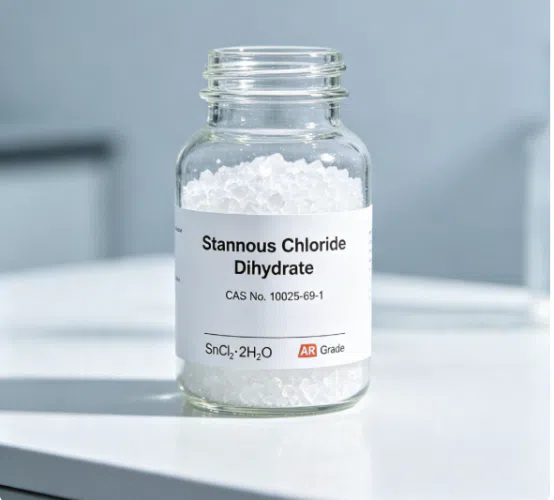
Stannous chloride (SnCl₂), also known as tin(II) chloride, is an important inorganic tin compound available in anhydrous and hydrated forms. It is valued for its strong reducing ability, excellent chemical reactivity, and wide range of industrial applications.
Anhydrous stannous chloride appears as transparent crystalline solids with a melting point of approximately 246°C and a boiling point of around 652°C. It is soluble in water but can be easily oxidized by air, forming insoluble tin oxide chlorides. In aqueous solutions, it may undergo hydrolysis and produce basic tin chloride precipitates. To improve solution stability, it is commonly dissolved in hydrochloric acid before dilution, while metallic tin can be added to help prevent oxidation.
Stannous chloride dihydrate (SnCl₂·2H₂O) is a colorless monoclinic or flaky crystalline material with a melting point of approximately 37.7°C. Upon heating, it gradually loses its crystallization water. Due to its excellent reducing capability and chemical versatility, it is widely used as a reducing agent, mordant, decolorizing agent, analytical reagent, and tin-plating material.
Industrial production of anhydrous stannous chloride is typically achieved through the reaction of molten tin with chlorine, while the dihydrate form is produced by reacting tin metal with hydrochloric acid followed by evaporation and crystallization.
With its reliable performance, controllable reactivity, and multiple application possibilities, stannous chloride dihydrate is an essential tin-based material for chemical, electroplating, textile, and analytical industries.
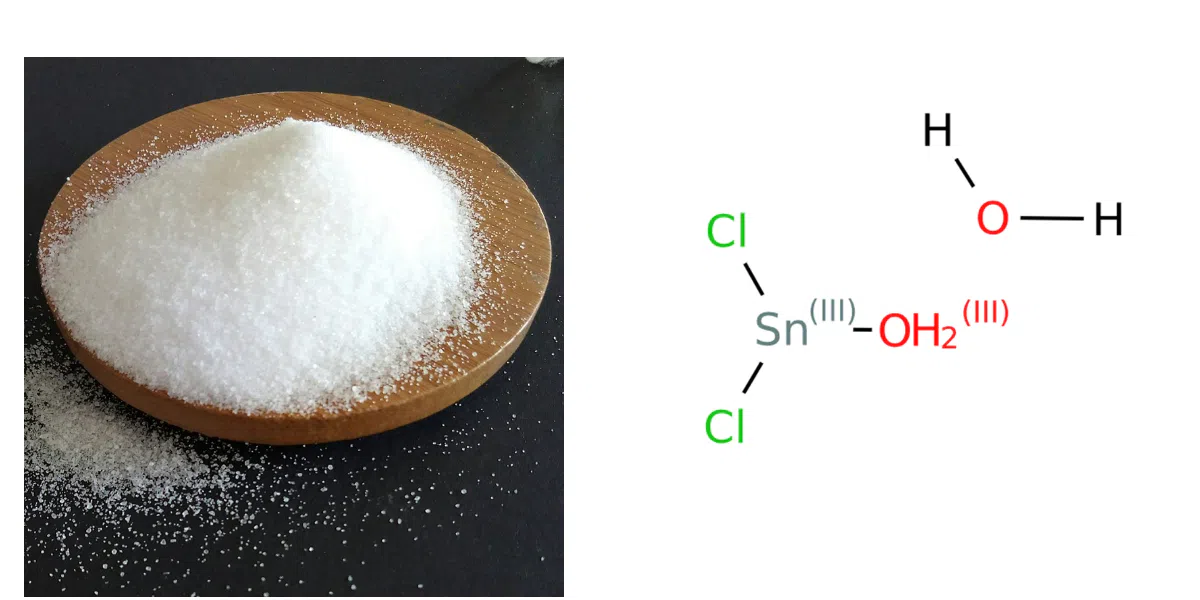
Stannous chloride dihydrate Chemical Properties
| Melting point | 37-38 °C (dec.)(lit.) |
| Boiling point | 652 °C(lit.) |
| density | 2.71 |
| storage temp. | Store at +15°C to +25°C. |
| solubility | hydrochloric acid |
| form | Solid |
| color | White or colorless |
| Specific Gravity | 2.71 |
| PH | 1-2 (100g/l, H2O, 20℃) |
| Water Solubility | 1187 g/L (20 ºC) |
| Sensitive | Air Sensitive |
| Merck | 148,783 |
| Exposure limits | ACGIH: TWA 2 mg/m3 |
| NIOSH: IDLH 100 mg/m3; TWA 2 mg/m3 | |
| Stability: | Stable. Incompatible with strong oxidizing agents, alkali metals, ammonia, alcohols, alkalies, nitrates, boron trifluoride, boron trichloride, carbides. |
| InChIKey | AXZWODMDQAVCJE-UHFFFAOYSA-L |
| CAS DataBase Reference | 10025-69-1(CAS DataBase Reference) |
| EPA Substance Registry System | Tin chloride (SnCl2), dihydrate (10025-69-1) |
Safety Information
| Hazard Codes | C,N |
| Risk Statements | 22-34-68-50/53-48/22-43-20-63 |
| Safety Statements | 26-36/37/39-45-61-60 |
| RIDADR | UN 3260 8/PG 3 |
| WGK Germany | 1 |
| RTECS | XP8850000 |
| TSCA | Yes |
| HazardClass | 8 |
| PackingGroup | II |
| HS Code | 28273910 |
| Toxicity | LD50 orally in Rabbit: 700 mg/kg |
Applications of Stannous Chloride Dihydrate CAS No. 10025-69-1
Stannous chloride dihydrate is a versatile tin-based compound widely used in chemical manufacturing, surface treatment, pharmaceutical synthesis, and specialty industrial applications due to its excellent reducing ability and chemical reactivity.
Chemical Synthesis and Reducing Applications
Stannous chloride dihydrate is commonly used as a reducing agent in the production of dye intermediates and fine chemical synthesis. It also serves as a catalyst or reaction promoter in various organic chemical processes.
Electroplating and Surface Treatment
In the electroplating industry, stannous chloride dihydrate is an important material for tin plating and copper–tin alloy plating of metal components. It is also used as a sensitizing agent for ABS plastics before electroplating, improving coating adhesion, enhancing surface quality, and reducing the risk of coating defects.
Glass, Mirror, and Coating Applications
Due to its reducing properties, stannous chloride dihydrate is utilized in mirror manufacturing processes as a sensitizer for silver or mercury plating, helping achieve uniform metallic coatings with improved adhesion and brightness. It is also applied as a bleaching agent in specific industrial processes.
Textile and Rubber Industry Uses
In textile processing, it functions as a mordant to improve dye fixation and is used as a resist agent in discharge printing. It can also act as an activator during the vulcanization process of butyl rubber products.
Pharmaceutical and Specialty Chemical Applications
Stannous chloride dihydrate plays a role in pharmaceutical intermediate synthesis and serves as a functional additive in various chemical formulations. It is also used as a stabilizer in flavor and fragrance-related applications.
Food and Other Industrial Uses
With appropriate quality standards, stannous chloride may be used as a reducing agent and antioxidant in certain food applications, helping maintain product quality in processed foods such as canned vegetables and fruit beverages.
With its strong reducing performance, excellent adaptability, and broad compatibility, stannous chloride dihydrate remains an important material for electroplating, chemical synthesis, surface treatment, and specialty manufacturing industries.